

They share a shape and a steel shell — and almost nothing else. Both instruments are made of steel, played with the hands, and tuned to fixed scales. Beyond that, they are fundamentally different instruments — in how they are made, how they sound, how they are played, and what they cost. Here is an honest, complete guide to help you decide which instrument is right for you.
How They Sound
While both instruments belong to the idiophone family—meaning the whole instrument vibrates to create sound—and look superficially similar, their acoustic profiles, physical mechanics, and sonic personalities are completely different.
The core difference comes down to how the metal vibrates, which directly dictates their timbre, projection, and performance dynamics.

Steel Tongue Drum: The Sound of Resonance
A tongue drum is constructed by cutting literal “tongues” (usually U-shaped or rectangular) into the top of a thick steel shell.
Timbre: The sound is incredibly resonant, warm, and meditative, often described as “bell-like”. It has a heavy, enveloping acoustic presence.
Sustain and Overtones: Because the thick metal tongues act like tuning forks, they ring out for a remarkably long time. This creates a dense, long-lasting wash of sound. However, because the tongues are structurally isolated from each other by the cuts, there is less natural sympathetic resonance across the rest of the shell.
Volume & Activation: The thicker steel requires more energy to get moving. While you can play them with hands, they are most frequently played with soft mallets to pull out a clear, loud, fundamental tone without heavy hand-striking noise.
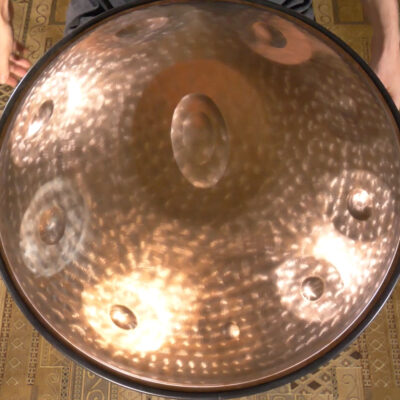
Handpan: The Sound of Dynamic Complexity
A handpan is made from thin, highly tensioned sheet metal (often nitrided or stainless steel). Instead of cuts, individual “tone fields” are painstakingly hammered and compressed into the shell, usually featuring a central indentation called a dimple.
Timbre: The sound is crisp, bright, metallic, and ethereal. It has a distinct “singing” quality that feels incredibly expressive, capturing a massive range of emotional nuance.
Acoustic Architecture: Every single tone field on a handpan is meticulously tuned to contain three distinct frequencies: a fundamental note, an octave, and a compound fifth (a 1:2:3 frequency ratio).
Sympathetic Resonance: Because the shell is a single, uninterrupted piece of tensioned steel, striking one note excites the air inside the chamber and sets off beautifully complex sympathetic vibrations across the other tone fields. The result is an intricate, layered matrix of overtones.
Dynamics and Playing Style: The thin, tensioned metal is highly sensitive and responsive. It is designed exclusively to be played with the hands. A light touch produces a clear tone, allowing players to weave percussive slaps, micro-tonal bends, and rapid, articulate melodic patterns together seamlessly.
The simplest way to think about it: a tongue drum gives you notes. A handpan gives you sound environments. One sits inside a song. The other becomes the atmosphere.
How They Are Built

Understanding construction explains the price difference better than anything else.
A steel tongue drum is made by cutting slotted “tongues” directly into a steel or alloy shell. The size of each tongue determines its pitch. The process is mechanically repeatable and relatively fast — which is why tongue drums can be mass-produced and purchased for $50 to $500.
A handpan begins as two steel shells — typically stainless steel, nitrided or hardened through builder-specific processes — that are hammered or pressed into curved forms, shaped into individual tone fields, and tuned by precision measurement so that each note produces its fundamental pitch plus specific harmonic overtones in harmony. The two shells are then glued together into a single resonating body. At Saraz, a single instrument can take weeks to complete. The tuning process alone — bringing each note into alignment with its overtones — is where the majority of that time is spent.
That is not marketing language. It is the reason no two handpans sound exactly alike, and why a high quality handpan cannot be replicated for a few hundred dollars.
What It Feels Like to Play Each One
A tongue drum is forgiving from the first minute. Pick one up, find the notes by touch, and you are making something musical within minutes. Most are tuned to pentatonic scales, so nearly any combination of notes sounds pleasing. Using mallets makes it even easier — no technique required to get a good sound.
A handpan rewards your attention over time. The instrument responds to where you place your fingers on the tone field, how hard you strike, your hand angle, and whether you let the sound breathe between notes. Early on it feels effortless — everything sounds beautiful — and that remains true. But deeper playing opens up as you develop sensitivity to how sound travels across the shell and how overtones interact with each other.
Neither is harder in a discouraging way. They simply ask for different things from the player.
Which One Is Right for You?
| Trait | Steel Tongue Drum | Handpan |
|---|---|---|
| Sound character | Bright, clear, staccato | Warm, resonant, immersive |
| Sustain | Long — notes blend together, can become muddy | Medium — overtones linger 5–10 seconds |
| Typical price | $50 – $500 | $2,000 – $5,000+ |
| Played with | Fingers or mallets | Fingertips and palm — hands only |
| Learning curve | Very low — intuitive immediately | Moderate — technique matters |
| Volume | Quieter, more contained | Louder — fills a room easily |
| Note count | 8–14 notes typical | 8–10 notes typical |
| Portability | Very portable, lightweight | Portable with a case |
| Availability | In stock, ships quickly | Often made to order or waitlisted |
| Value retention | Depreciates quickly | Holds value well from reputable builders |
Consider a tongue drum if…
- You are new to instrument ownership
- Budget is a firm constraint right now
- You want something a child or family can play freely
- You need an instrument immediately, without a wait
- Meditation or low-pressure exploration is the goal
- You want to confirm this soundscape interests you before a larger investment
Consider a handpan if…
- You have heard one and cannot get the sound out of your head
- You are a musician looking for a meditative or solo instrument
- You want an instrument that grows with you over years
- You perform, record, or take music seriously as a practice
- You value owning something handmade and unique
- You are ready to invest in an instrument, not just a purchase
A word of caution on “cheap handpans”: You will find instruments advertised as handpans online for $300–$800. These are almost always tongue drums built to look like handpans. There is nothing wrong with a tongue drum — but if you are expecting a handpan’s resonance, overtone depth, and sustain at that price, you will be disappointed. The price difference is structural, not a markup. Explore our Buyer’s guide of the tiers of handpan cost and quality.
Frequently Asked Questions
Can a tongue drum replace a handpan?
For casual play and general exploration, it can fill a similar role. For the specific sound experience a handpan provides — the sustained bloom, layered overtones, and room-filling resonance — no. Those qualities are not replicated by a tongue drum regardless of its quality level.
Is a tongue drum a good first step toward buying a handpan?
It can be. A tongue drum provides a similar scale layout, develop basic rhythmic habits, and confirm that this musical world genuinely interests you. Some players find the transition natural. Others find the instruments feel different enough that the tongue drum offered limited preparation — but no musical experience is ever wasted.
Do I need musical training to play either instrument?
No. Both are fixed-scale instruments and forgiving of improvisation. Prior musical experience will help you develop faster, but it is not a prerequisite for either.
Can a handpan be played with mallets?
Handpans are designed to be played with the hands. Mallets are strongly discouraged as they can damage the tuning. If mallet playing is important to you, a tongue drum is the better choice.
What is the difference between a handpan and a hang drum?
These terms are often used interchangeably. The Hang® is a specific instrument made only by PANart in Switzerland. “Handpan” is the general term for all instruments inspired by it. Read the full story here.
How long is the wait for a Saraz handpan?
Custom orders typically ship in approximately 8 weeks. We also carry in-stock instruments that ship immediately — these move quickly when available. Contact us for current lead times and more details.
Ready to Find Your Saraz?
With 14+ years of experience, one of the largest scale lists available anywhere, and instruments shipped to players across the USA and Europe, Saraz is one of the most trusted names in handpan building worldwide. We are always happy to answer questions and help you find the right instrument.
Read the Complete Buyer’s Guide