

Two Materials. One Clear Choice.
Saraz has spent over a decade building handpans on both stainless and nitrided steel. Here’s everything we’ve learned — and why we now build exclusively on stainless.
Introduction
If you’ve started researching handpans, you’ve probably encountered the steel debate: nitrided or stainless? It’s one of the first real decisions a buyer faces, and it matters. The material your handpan is made from shapes how it sounds, how it feels under your hands, how it ages over years of play, and how much ongoing care it needs.
We’ve built hundreds of instruments on both. We know this topic from the inside — not from a spec sheet, but from thousands of hours tuning, testing, playing, and listening to how both materials behave over time.
Here’s the full picture.
What Is Nitrided Steel?
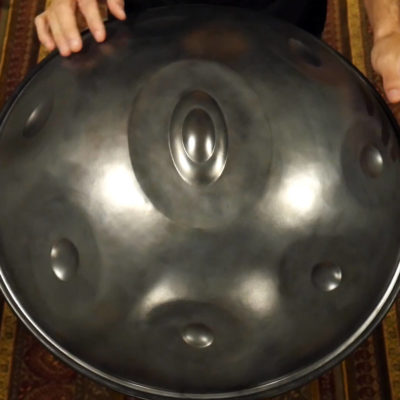
Nitrided steel begins as raw low-carbon steel (most commonly DC04 or 1008) that is hardened through a high-temperature heat-treating process. Nitrogen is diffused into the surface of the metal, which increases its hardness and improves rust resistance compared to raw steel. The result is a darker instrument — typically charcoal gray, gunmetal, or a deep bronze — with a sound many players describe as ceramic, percussive, and slightly dry.
Nitrided steel is where the handpan tradition began. The original Hang from PANArt used a form of nitride-treated steel, and for years it was the only real option. Many beloved instruments have been built on it, and in skilled hands it still produces deeply musical results.
That said, nitrided steel comes with trade-offs that become more relevant the longer you own and play your instrument.
What Is Stainless Steel?
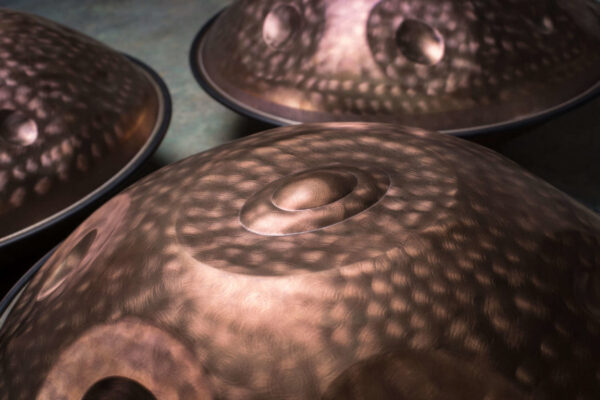
Stainless steel is a chromium-rich alloy that is naturally corrosion-resistant — no heat treatment required. The chromium content forms a self-healing protective layer on the surface of the metal, which is why stainless doesn’t rust under normal conditions. Visually, stainless handpans often carry a warmer gold, copper, maroon finish, or a clean silver tone depending on the alloy and builder.
Stainless is a harder material to work with, particularly when hand-hammering by skilled craftspeople. It resists shaping more than nitrided steel, which is part of why it took longer to become widespread in the handpan world. Relative to nitrided steel, it is also harder to stabilize without the right techniques and heating process. But builders who mastered the craft unlocked something remarkable: longer sustain, richer harmonics, and a more forgiving, resonant tone.
Saraz was among the first builders in the world to develop stainless steel handpans before mass-produced shells were available. Using pneumatic hammers to form the stainless shell requires about twice as much time and hammer strikes as cold rolled steel so we were delighted when pressed shells became available.
How They Sound: The Real Differences
This is what most buyers want to know. Both materials can produce a beautiful handpan, but they sound different in ways that are meaningful and consistent.
Stainless Steel: Notes ring out longer, with a warm, sustained tone that layers harmonically. Stainless tends toward a floating, atmospheric quality — ideal for meditative playing, sound healing, ambient music, and slow melodic lines where you want notes to breathe and overlap. The attack is softer and the overall character is smooth and immersive.
Nitrided Steel: Notes are shorter and more defined, with a crisper attack and quicker decay. Many players describe the sound as percussive, ceramic, or “gong-like.” This character suits rhythmic playing and fast passages well, where note separation matters more than sustained resonance. The timbre tends to be darker and moodier.
Neither is objectively superior. But when most buyers describe their ideal handpan sound — resonant, warm, meditative, and rich — they’re describing stainless steel. It’s worth being honest about that. Our customer requests speak for themselves. Around 2022, 98% of our customers orders organically became stainless steel. Personally, we prefer to build and play stainless steel instruments.
Durability and Maintenance
This is where the practical differences become most significant.
Nitrided Steel is rust-resistant, but it is not rustproof. The nitriding process provides a protective layer, but that layer is vulnerable to sweat, salt, humidity, and coastal air. Without regular care, nitrided instruments can develop surface rust — cosmetic at first, but damaging over time if neglected. A proper care routine means wiping the instrument after every session and oiling it every two to four weeks with a handpan-specific oil. For players in humid climates, near the coast, or who simply want to set the instrument down and pick it up without a maintenance checklist, this is a real burden.
Stainless Steel does not rust under normal conditions. You should still wipe your instrument after playing — sweat and oils can discolor the surface over time — but regular oiling is optional rather than essential. Stainless is the practical choice for outdoor performances, humid environments, touring musicians, and anyone who wants their instrument to stay beautiful with minimal intervention. If you live near the coast, the humidity can discolor the patina if the instrument is not regularly waxed or oiled, however rust pitting deep into the steel is virtually unheard of on stainless steel.
Beyond rust, stainless steel’s material consistency is an advantage for builders. Nitrided steel can vary batch to batch — different raw steel sources, different nitriding processes and even degrees of nitriding within a single batch — which means two instruments from the same maker can behave differently. Stainless is more predictable, which supports more consistent tuning and long-term stability.
| Trait | Stainless Steel | Nitrided Steel |
|---|---|---|
| Appearance | Gold, copper, maroon, or silver finish | Charcoal gray, gunmetal, or dark bronze |
| Sound character | Warm, resonant, atmospheric | Percussive, ceramic, defined attack |
| Sustain | Longer — notes breathe and layer | Shorter, more controlled decay |
| Rust resistance | Excellent — virtually rustproof | Good — but requires regular oiling or waxing |
| Maintenance | Minimal — wipe after playing | Oil every 2–4 weeks; wipe after every session |
| Best for | Meditation, sound healing, ambient and melodic play | Rhythmic playing, fast passages, outdoor busking |
| Batch consistency | High — predictable across instruments | Variable — depends on maker and nitriding process |
| Built by Saraz today? | Yes — all current instruments | No — Saraz builds exclusively on stainless |
Why Saraz Builds on Stainless
We didn’t make this decision lightly or quickly. Saraz has been building handpans since 2011 — longer than 98% of makers in the world today — and for years we offered both materials. We’ve tuned thousands of instruments, listened to how they age, fielded questions from players about rust and maintenance, and watched how both materials hold up over real years of use.
The transition to stainless-only was a conclusion, not a marketing choice.
Stainless steel allows us to build instruments with greater consistency, longer sustain, and lower lifetime maintenance without asking players to compromise on tone. It suits the way most of our players actually use their instruments — for meditation, introspection, sound healing, slow melodic play — and it removes a layer of long-term uncertainty that nitrided instruments carry.
We also believe an instrument should last many lifetimes. Stainless is built for that.
Frequently Asked Questions
Does a stainless steel handpan sound as warm as nitrided? Yes — and in many cases warmer, with richer sustain and harmonic depth. The “warmth” often associated with nitrided steel is really a function of its quicker decay and percussive definition. Stainless offers a different kind of warmth: full, sustained, and harmonically layered.
Does stainless steel ever rust? Stainless steel is highly resistant to rust but not completely immune under extreme conditions. Wiping your instrument after playing is always recommended. In normal use — including humid climates and casual outdoor play — stainless holds up exceptionally well.
Which material is better for a beginner? Stainless steel is the stronger choice for most beginners. The lower maintenance requirement means one less thing to worry about as you develop your practice. The longer sustain is also forgiving and rewarding to learn on.
Why did Saraz stop making nitrided instruments? After more than a decade building on both materials, we concluded that stainless steel better serves our players and better reflects the standard of quality we hold ourselves to. It produces a more consistent instrument, requires less maintenance, and holds up beautifully over time. We’re proud of that decision.
Ready to Order Your Saraz?
Every Saraz is built on stainless steel, by hand, in Asheville, NC — and fully customizable to your chosen scale.
Custom order production requires approximately 6-8 weeks.
Crafted in Asheville, NC. Playing since 2011.