

In Stock and Custom Order Handpans for sale
Sound as a form of therapy and healing is something most everyone can relate to. We listen to music when we are happy and sad, celebrating or mourning. Music has a way of channeling and transforming emotions into something more rich and palpable. A popular quote, likely erroneously attributed to Plato, spells it out best:
“Music gives a soul to the universe, wings to the mind, flight to the imagination and life to everything.”
In recent years, sound healing, also called sound therapy and sound healing, has evolved into a therapeutic field that uses sound to treat stress, anxiety, depression, PTSD, and more. Sound healers and therapists often use sound vibrations to promote relaxation and reduce stress so it is no surprise that particular emphasis is placed on the actual instruments generating the sounds and songs that impact our emotional, spiritual, and physical state.
While handpans are fairly new instruments, sound healers around the globe laud their hypnotic, relaxing, dreamy, and meditative sound qualities. We couldn’t agree more.
Sound Therapy Terminology
Sound vibration is central to the tenets of how sound healing works. Everything in the universe has a vibration, and many sound-healing practitioners believe that music or sounds that replicate other types of vibrations found in nature may have a positive effect on health and wellbeing. To better understand how handpans support notions of sound healing, we first need to dial in on a few musical terms that come up in sound-healing circles:
- Frequency – Frequency is the speed of vibration. Each musical note vibrates at a different frequency. If you move from left to right across a piano, the frequency increases as higher pitched notes vibrate at a higher frequency.
- Hertz (Hz) – Hertz is the measurement of frequency as beats per second. The frequency of middle C on the piano is 261.63 Hz. The frequency of a hummingbird’s wing beat is around 80 Hz. A crash cymbal can be composed of frequencies from 400 – 12,000 Hz.
- Resonance – Resonance is the length of time a sound is sustained at a certain frequency after the cause is removed. In music, for example, resonance would be the length of time of a sound after striking a cymbal, drum, or handpan. When you use the pedals of a piano, you add resonance. “Sustain” is also used synonymously with resonance.
Sound Healing Instruments
The best instruments for sound healing are those that vibrate at the desired frequencies and help you reach a meditative state. Many sound therapist and healers believe that specific sound frequencies are better able to reduce stress and improve physical and mental well-being.
Handpan Frequency Magic
Handpans have been called the holy grail of sound therapy and healing largely due to their superb resonance and full sound emanating in all directions. Each handpan is hand hammered, shaped from steel, and tuned by hand. The very act of playing a handpan is an intimate and meditative experience as you gently tap the notes with your fingers. Handpans being used for sound therapy and meditation are a growing practice that we are happy to encourage.
“It’s amazing how many clients are drawn in by the sound and energy of my Saraz handpans. I use them for every session. Just tapping a few notes fills the room with magic. Regardless of tempo, slow or fast, the resulting feeling is that of an angelic presence. Everyone wants to play the Saraz handpan afterwards!” – Billy Zanski, Sound Healer and Owner of Skinny Beats
Quality handpans (and steel drums) are among the very few instruments where each note is tuned to a 1:2:3 frequency ratio. That means there are 3 frequencies in each note anytime it is played including a fundamental tone, an octave harmonic and a compound fifth harmonic! The second frequency (the octave) is exactly half the size of the first (fundamental), and the third frequency (the compound fifth) is, you guessed it, 1/3 the size of the first (fundamental). We are not aware of any other musical instruments tuned like this beyond quality steel drums.
Choosing the Right Handpan for Sound Healing Work
If you’re selecting a handpan specifically for sound baths, yoga classes, or one-on-one therapeutic sessions, a few choices matter more than others.
Material: Stainless Steel for Maximum Sustain
While nitrided steel offers a beautiful, earthy tone, stainless steel produces longer-ringing overtones and a brighter, more “singing” sustain — the quality most sound healers are chasing when they want a single note to fill a room and linger. Stainless steel is also lower-maintenance, which matters if your instrument travels with you between sessions and spaces.
Scale: Celtic Minor or Pygmy for Accessible, Non-Dissonant Soundscapes
Both scales remove notes that could create tension or “wrong note” sensations, making them ideal for group settings where clients may want to play along.
- D Celtic Minor offers an airy, spacious quality well-suited to yoga and meditation spaces. It’s also one of the most popular beginner-friendly scales, so clients curious about trying the instrument themselves will find it especially welcoming.
- Pygmy scales create an earthy, grounding tone popular in sound bath work, often built around a minor pentatonic structure with a warm, ancient feel.
Note Count: Fewer Notes, More Room to Breathe
An 8 to 10-note layout gives each tone field more physical space, which translates to cleaner sustain and less unintentional sympathetic ringing between adjacent notes — useful when you want individual tones to stand out clearly in a quiet room. More complex “mutant” layouts with bottom notes can be stunning but are better suited to intermediate and advanced players seeking melodic range rather than sustained, immersive tones.
Tuning Standard: Match Your Practice
If you collaborate with other musicians or instruments tuned to standard concert pitch, 440Hz keeps you compatible. If your practice is entirely solo or paired only with other 432Hz instruments, a 432Hz tuning may suit your aesthetic. Read our full comparison of 432Hz vs 440Hz tuning for more detail.
Our Recommendation
For most sound healing practitioners, a stainless steel handpan in D Celtic Minor or a Pygmy scale, with 9-10 notes, tuned to 440Hz or 432Hz depending on your practice, offers the ideal combination of sustain, accessibility, and tonal warmth.
Explore our stainless steel handpans or browse our full scale list to find the right fit for your work.
Explore Handpans for Your Practice
The guidance above applies broadly to sound healing work, but different settings have their own considerations. We’ve put together dedicated guides for two of the most common practices:
Handpan for Yoga Teachers If you’re integrating a handpan into yoga classes, this guide covers how to weave it into a sequence, what to consider for group settings, and which scales work best when students are listening (or playing along) at different skill levels.
Handpan in Sound Bath Therapy If your practice centers on immersive sound bath sessions, this guide covers layering a handpan with gongs and singing bowls, room acoustics for larger groups, and how to use sustain and “wash” to guide a session’s arc.
Why does handpan frequency ratio matter?
Sense and perception research psychologists have stated that when our brains hear any soundscape, it is first trying to simplify as many ratios as possible while focusing mainly on the vocal range of frequencies. Basically, a handpan is ear candy because the ratios are already simplified into the most primary ratio possible. Saraz founder, Mark Garner, hypothesizes that the resulting sound of the frequency ratios is one of the reasons why many people instantly fall in love with these instruments.
Singing Bowls
Singing Bowls represent an ancient form of sound healing and therapy. In some Buddhist traditions, the sound of a singing bowl signals the beginning and end to meditation sessions. Tibetan singing bowls are typically made from a bronze alloy and are played by striking or rubbing the rim with a mallet that causes the bowl to vibrate and emit sound.
Didgeridoo
The didgeridoo is an ancient Australian hollow tube wind instrument originally used in ceremonies and rituals. The first didgeridoos were made of wood, but now you can find them made from a host of materials ranging from fiberglass to leather. The didgeridoo creates sound when a player vibrates their lips and blows into the tube, causing the air inside the instrument to vibrate at different frequencies and produce sound.
Gongs
Gongs have been used in ceremonies, rituals prayer and meditation for an estimated 4000 years. The sound can be calming and relaxing while also energizing and transforming. These powerful sound sculptures have become increasingly popular in Sound Meditations and therapy sessions.
Sarod, Tabla and Handpan
Classical Indian Music is perhaps one of the highest standards of both virtuous musicianship and deeply spiritual meditation. Sitar greats like Ravi Shankar and Zakir Hussain popularized this ancient genre of music over the last 60 years while the East – West collaborations have only grown since then. The following is a stellar video by one of our favorite customers and players, Adam Maalouf accompanied by Sarod and Tabla.
Handpan, Vocals, Violin and Percussion
Another great combination of instrumentation is exemplified in this Middle Eastern Piece, Bint el Shalabiya by Adam Maalouf (Saraz Handpans), Layth Sidiq (violin), Mariam Abuamer (vocals) and Jeremy Smith (percussion).
Interviews with Sound Healers, therapists, and Meditation Guides
The handpan creates a sound which many people feel is more than just music. In the following series of interviews, we explore how people from various walks of life approach the handpan for healing, meditation and therapeutic purposes. Join us we discuss these dynamics and the experiences with the practitioners themselves.
More Than Music – Episode 1. Billy Zanksi on Sound Meditation with Handpans
Join Billy Zanski at Skinny Beats Sound Shop in Asheville, North Carolina as he explores sound healing and meditation with Saraz Handpans, Crystal Bowls and Gongs.
More than Music Ep 2. Rob Jacoby: Handpans, Horses, EMDR and Psychology
Join Rob Jacoby MS, LPCS, at his Counseling Office in Asheville, NC as he discusses Handpans, Equine Therapy and EMDR in his psychology work.
More Than Music Episode 3: Kara Cura: Plant Medicine Ceremonies, Handpans, and the Asheville Salt Cave
Join Kara Cura at the Asheville Salt Cave as she shares with us her journey into Plant Medicine Ceremonies and Handpans.
More Than Music Ep. 4: Yogi Shelly: Yoga, Sound Therapy and Handpans at Horse shoe Farm
Join Yogi Shelly at Horse Shoe Farm as she shares with us her experience with teaching Yoga, Sound Therapy and Handpans in her work.
More Than Music Ep. 5 River Guerguerian: Musical Intention, Communication, and Transcendent Soundscapes of Trance
Join River Guerguerian as he discusses teaching, performing with bands and conducting sound baths.
440 Hz, 432 Hz, and Specific Sound-Healing Frequencies
Most instruments, including most handpans, are tuned to the standard 440Hz concert pitch. However, some sound healers and meditation practitioners prefer instruments tuned to 432Hz, believing it creates a warmer, more grounding tone better suited to therapeutic work.
Whatever frequency you choose, it’s the relationship between notes — not the absolute pitch — that creates harmony. Both standards can produce beautiful, effective instruments for sound healing.
One important note: 432Hz and 440Hz instruments should not be played together, as the pitch difference creates an out-of-tune “beating” effect rather than harmony. If you plan to use your handpan alongside other instruments (singing bowls, other handpans, recorded tracks), make sure everything shares the same tuning standard.
Read our full comparison of 432Hz vs 440Hz tuning to explore the history, sound character, and practical considerations of each.
Another example of a different tuning standard philosophy comes from Classical Indian Music, which is commonly played on Sitar and Tabla. In this style of music, there is no universal standard. Players tune to each other and, more philosophically, the tuning standard of the present moment. The Sitar and Tabla are designed specifically for the fluidity of not only tuning standard flexibility but also the flexibility of the intervals between notes. You may experience this tuning philosophy when sitting around the campfire with a few guitar players that find they need to tune to each other in order to play together. Whatever tuning standard is chosen, it is important to realize that it is the ratio of frequencies of different notes that create harmony, and it is possible to create harmony based on any tuning standard.
Learn more about sound healing at the Sound Healers Association.
Saraz Handpan Tuning and Frequencies
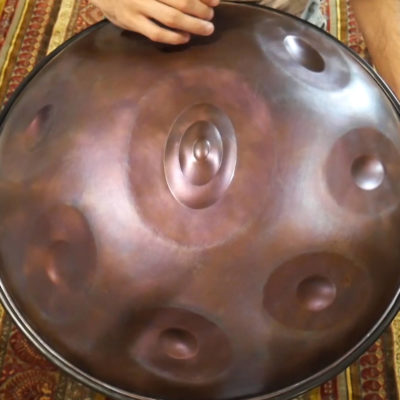
Saraz handpans can be built in any tuning standard. While we have built most Saraz based upon 440 Hz due to popularity, we have also built instruments by request in 432 Hz and even 444 Hz. It’s important to note that Handpans should only be tuned by a professional who has extensive experience. Handpans are not flexible and cannot be tuned, for example, with the ease of a guitar.
If you are interested in a custom handpan tuned at a specific frequency, please get in touch! We have also recently developed a fully customizable line of handpans with the sound healer in mind. Our beautiful stainless steel handpans are characterized by long sustaining dreamy, hypnotic, and meditative tones.
Learn more about Saraz handpans and our Custom made instruments.